
Busy season remains one of the most demanding periods for public accounting professionals. Once it’s over, we ask tax and audit staff across North America about their experience, from workload and stress to recognition, support and work-life balance.
This report looks back at the 2025/26 busy season and compares the findings with last year’s survey.
Busy season 2025/26: Key takeaways
- Managers are feeling the pressure
Overall stress levels remain high, with 57% describing busy season as somewhat or extremely stressful. The biggest shift is that Managers are now just as likely as Seniors to report high stress levels.
- Long hours are still the norm
Almost eight in ten respondents (78%) worked more than 50 hours a week, with 51-60 hours remaining the most common working week.
- Work-life balance remains a challenge
Overall ratings changed very little, but Managers reported a significant decline, with over half describing their work-life balance as poor.
- Seniors feel the least recognized
Average recognition fell slightly from 6.5 to 6.1 out of 10, with senior tax and audit professionals reporting the lowest scores of any group.
- Support makes a clear difference
Fewer professionals received useful tools or perks this year, but those who did felt far more valued. Recognition scores averaged 8.6 out of 10 among those who received both, compared with just 2.9 for those who received neither.
In-depth analysis of busy season 2025/26
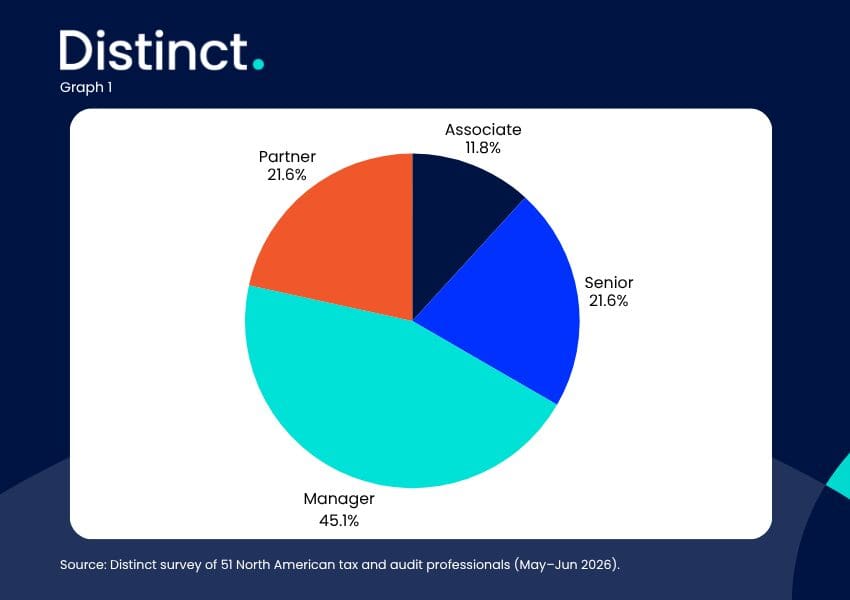
Before exploring the results, it’s worth noting that this year’s respondents were generally more experienced than last year’s. Managers made up 45% of the sample, with seniors and partners each accounting for 22% and Associates 11%.
Nearly seven in ten respondents (69%) had experienced eight or more busy seasons, providing valuable insight from professionals with extensive busy season experience. Despite the more experienced audience, the overall themes remain consistent with last year’s survey.
Workload & hours across busy season 2025/26
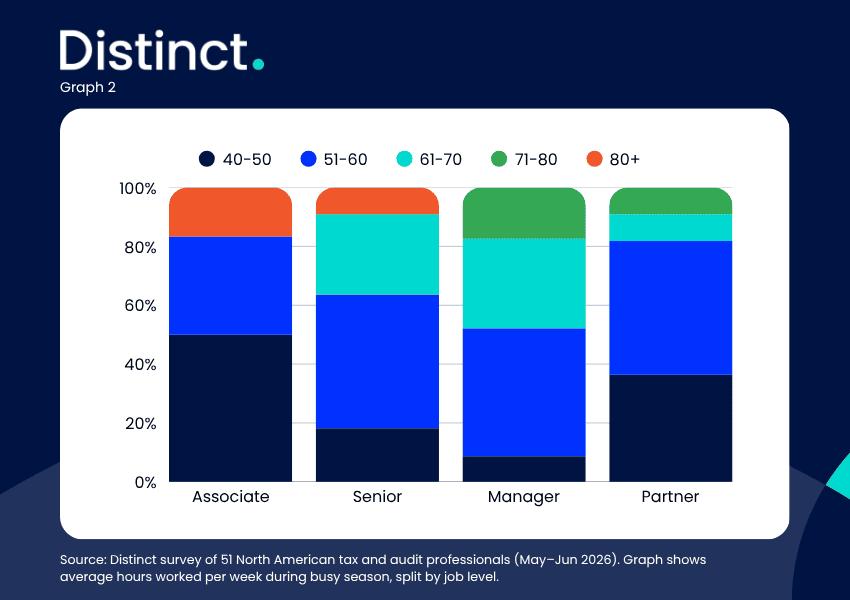
Long hours continue to define busy season. 78% of respondents worked over 50 hours a week (broadly in line with last year), with the standard 51-60 hour workweek reported by 43% of respondents (down from 48%).
- Managers bore the heaviest load: 30% worked 61-70 hours and 17% worked 71-80 hours. However, those exceeding 70 hours dropped significantly from 38% last year to 17% this year
- Partners also saw fewer extreme hours, with only 9% working >70 hours (down from 21%)
- Associates generally logged shorter weeks (50% worked 40-50 hours; 33% worked 51-60 hours), though few reported working >80 hours.
Overall, while fewer CPA leaders are touching extreme 70+ hour thresholds, sustained overtime between 51 and 70 hours remains the universal baseline.
The shift in stress and burnout
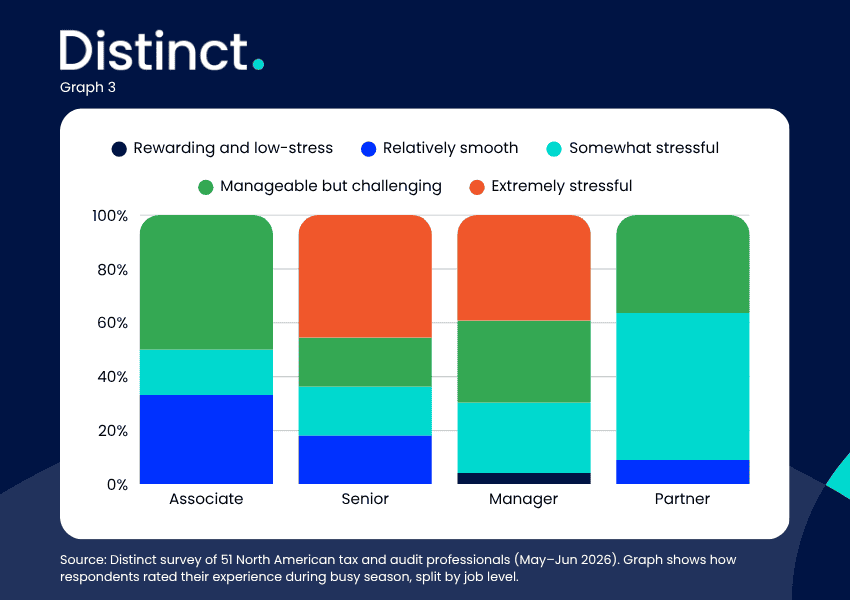
Overall experience changed little year-on-year: 57% described busy season as somewhat or extremely stressful (up from 55%). However, the internal distribution of that pressure shifted with managers catching up to seniors. Last year, senior tax and audit professionals felt the most strain (75% reported high stress). This year, managers joined them at the top – with 65% of managers and 64% of seniors reporting high stress.
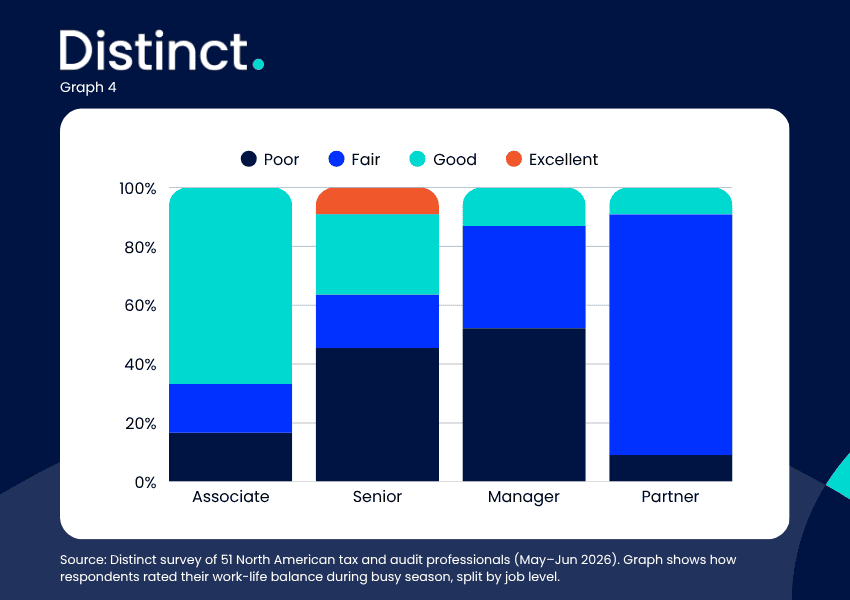
Work-life balance followed a similar downward trend, led by a sharp drop among managers. Over half (52%) rated their balance as poor – more than double last year’s figure and the largest single year-on-year shift in the survey. Meanwhile, seniors continued to report exceptionally poor balance, virtually identical to last year.
On the lighter side of the spectrum, partners saw extreme stress soften into “somewhat stressful”, while just 17% of associates reported high stress.
The recognition gap widens
Average recognition across all respondents fell slightly from 6.5 to 6.1 out of 10, but the divide between career levels broadened:
|
Level |
Recognition score (out of 10) |
Trend vs. last year |
|
Partners |
8.6 |
↑ from 7.6 |
|
Managers |
5.3 |
↓ from 6.3 |
|
Seniors |
4.8 |
↓ from 5.9 |
|
Associates |
7.2 |
↑ from 6.3 |
While mid-career professionals struggled with recognition last year, 2026 data shows the gap concentrating heavily on senior tax and audit professionals.
As Alex Alcock, Director at Distinct warns, “As professionals become more experienced, expectations increase quickly, but recognition doesn’t always keep pace. That’s a challenge for firms because today’s seniors are tomorrow’s managers. If they don’t feel valued during that transition, retaining them becomes much harder.”
Support makes a measurable impact
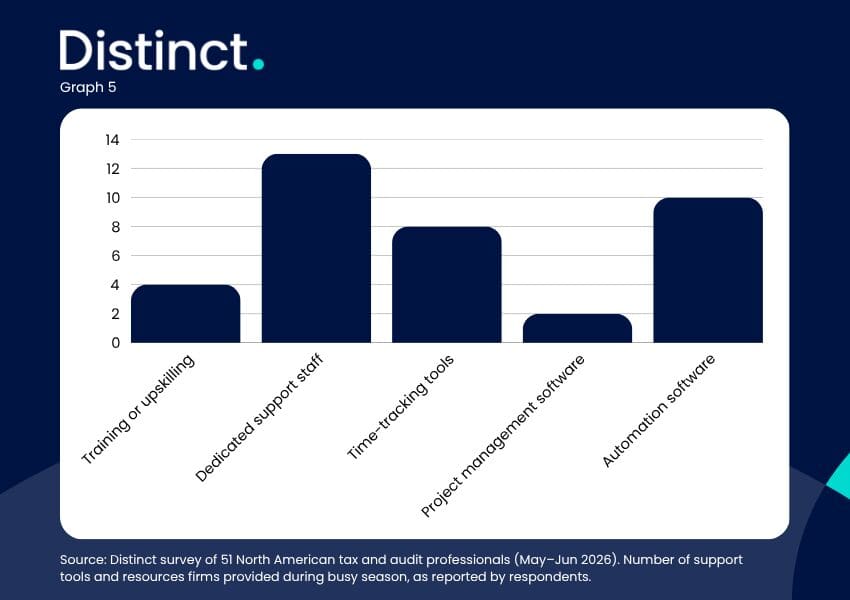
Compared with last year, fewer professionals reported receiving structured support during busy season. Just 41% said their firm provided tools or resources to help manage the workload, down from 53%.
Dedicated support staff or outsourcing remained the most common form of practical support (received by ~25% of respondents), while automation software and time-tracking tools fell out of favor.
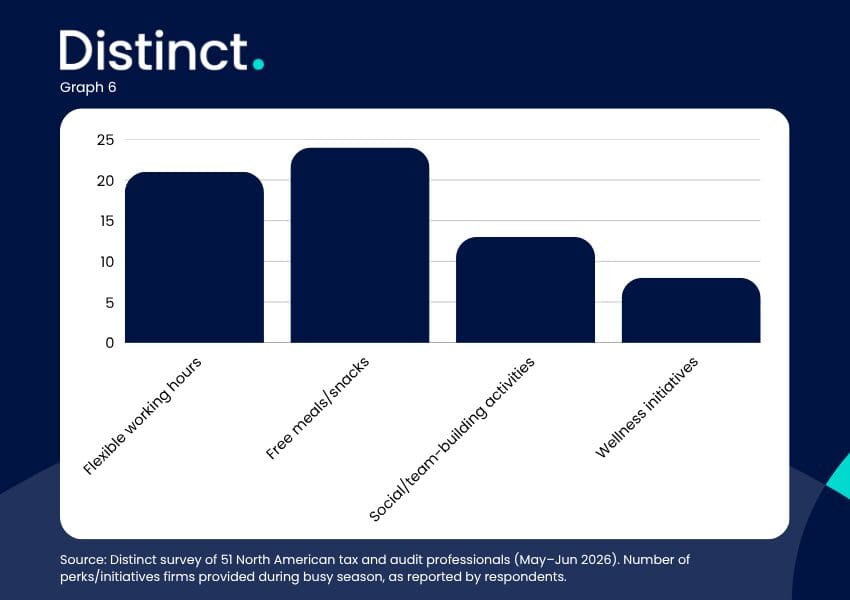
Among perks, 61% of respondents received benefits such as free meals, snacks or flexible working, down from 76% last year. The biggest declines were in free meals and flexible working hours, while team-building activities and wellness initiatives remained broadly unchanged.
Although fewer firms offered structured support this year, its impact was clearer than ever.
Professionals who received both useful tools and perks reported an average recognition score of 8.6 out of 10, compared with just 2.9 among those who received neither – a difference of 5.7 points on a 10-point scale. The benefits extended beyond recognition too. Respondents who received useful tools were around half as likely to describe busy season as stressful (38%) vs those who received no practical support (78%).
One interesting addition this year came from a partner whose firm paid a bonus for every tax return completed during busy season. While this was only mentioned once, it reflects a different approach to support – rewarding performance directly, rather than relying on traditional perks. It’s too early to call it a trend, but it’s an approach worth watching.
“The drop in support is disappointing, especially given how clear the link is between support and recognition. But the good news is that firms aren’t powerless. Our report clearly shows that small investments in practical tools, flexibility and meaningful support can have a significant impact on how people experience busy season and whether they feel valued afterwards. That’s a positive message for any firm looking to strengthen retention.” Alcock, Director at Distinct.
In summary
Busy season remains demanding, but this year’s findings show the pressure is shifting. Managers are now experiencing stress levels on par with seniors, while seniors report the lowest levels of recognition.
The good news is that firms can make a meaningful difference. Practical support has a clear impact on how valued professionals feel, giving firms an opportunity to improve both the busy season experience and retention. With the fall deadlines approaching, now is the time to put those lessons into practice.
For those looking to bolster their team ahead of the deadlines, or perhaps considering their next CPA firm carefully, Distinct’s public accounting team is here to help, get in touch today.
